A Simple Family Stargazing Night
Use dark adaptation, a few landmarks and patient observation after sunset.
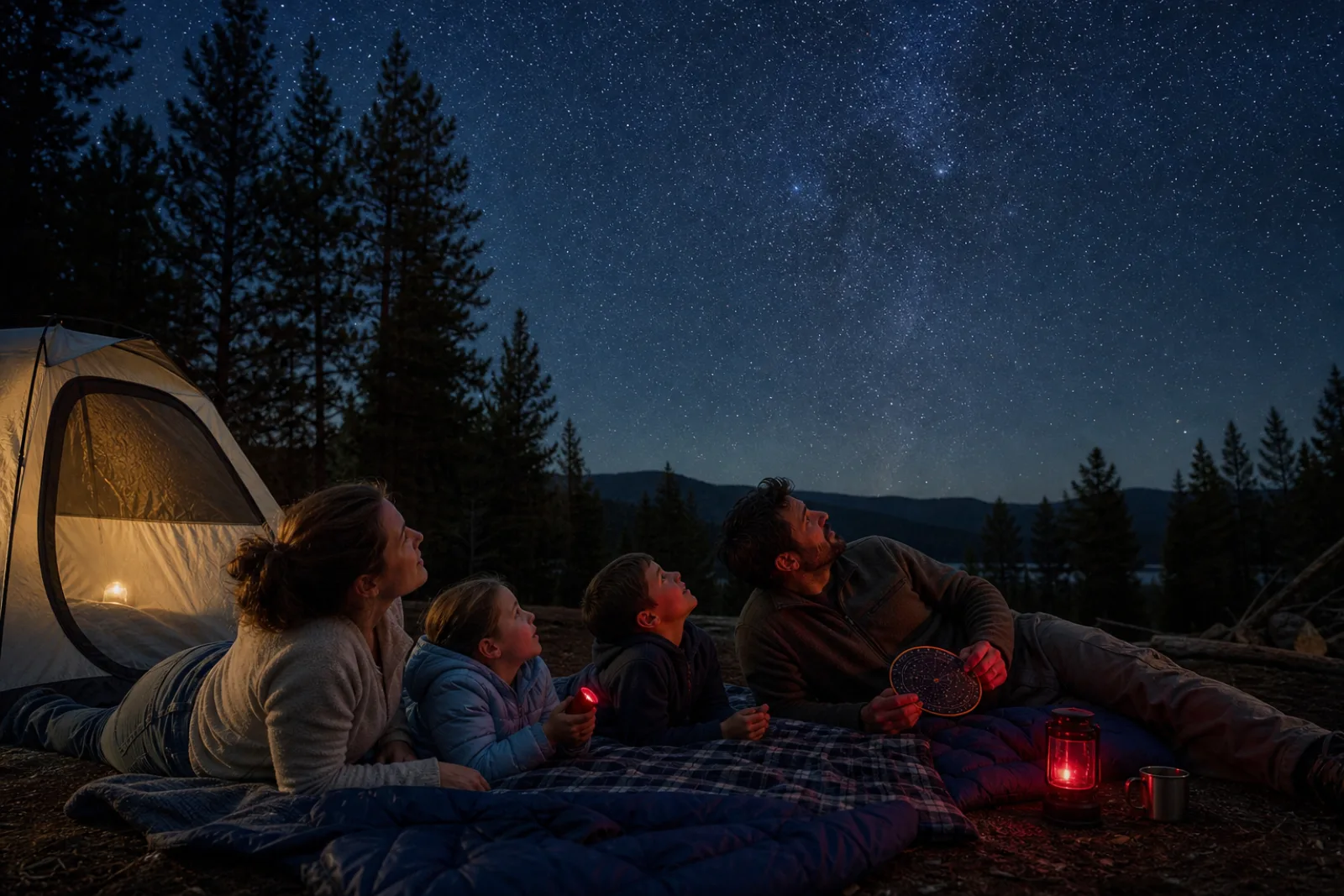
Stargazing does not require a telescope or a remote expedition. A clear view, warm layers and enough time for eyes to adjust can turn the area beside a tent into an evening activity that works across ages.
Begin with the sky you have
Choose an open, permitted spot with safe footing and a simple route back to camp. Turn off unnecessary white lights and let eyes adapt gradually. Even near a town, families may see the moon, bright planets and major star patterns. A darker site reveals more, but darkness is not worth walking into cliffs, roads or wildlife habitat.
Learn two anchors
In the Northern Hemisphere, the Big Dipper can help point toward Polaris, the North Star. Cassiopeia’s W shape is another useful pattern near the northern sky. Seasonal patterns such as the Summer Triangle can lead to additional constellations. Treat identification as a shared guess-and-check activity rather than a quiz.
Add low-cost tools
A rotating star chart works without service and can be set for date and time. A stargazing app can help, but use a dim red display and download data before leaving coverage. Ordinary binoculars reveal more stars and lunar detail. Borrow a telescope from a library or attend an astronomy-club event before deciding whether to buy one.
Make it comfortable for children
Bring a blanket or reclining chairs, warm clothing, water and a quiet snack. Give younger children short missions, such as finding the brightest object or inventing a shape between three stars. Keep beams pointed at the ground, never at people, wildlife, vehicles or aircraft. End before cold and fatigue replace curiosity.
Check tonight’s conditions
Cloud cover, smoke, moon phase and seasonal sky position change what is visible. Consult a current official weather and air-quality source, plus a reliable observing guide for the exact location and date. Tell another adult where the viewing group will be and keep the return path recognizable. Follow campground quiet hours and dark-sky lighting rules. If storms are possible, skip the open viewing area and return to appropriate shelter rather than waiting for one more break in the clouds.